Escape the Behavior Trap: Part 3
Three Easy Steps for Real Behavior Change: Just Follow the A.B.C.s

In Part 1 and 2 of this series, we explored the four hidden reasons behind student behavior and identifying what the student can do instead - a behavior that meets the same need in a more productive way. Oftentimes teaching the replacement behavior is all we need to make a change. Sometimes however, a closer look at the behavior is required.
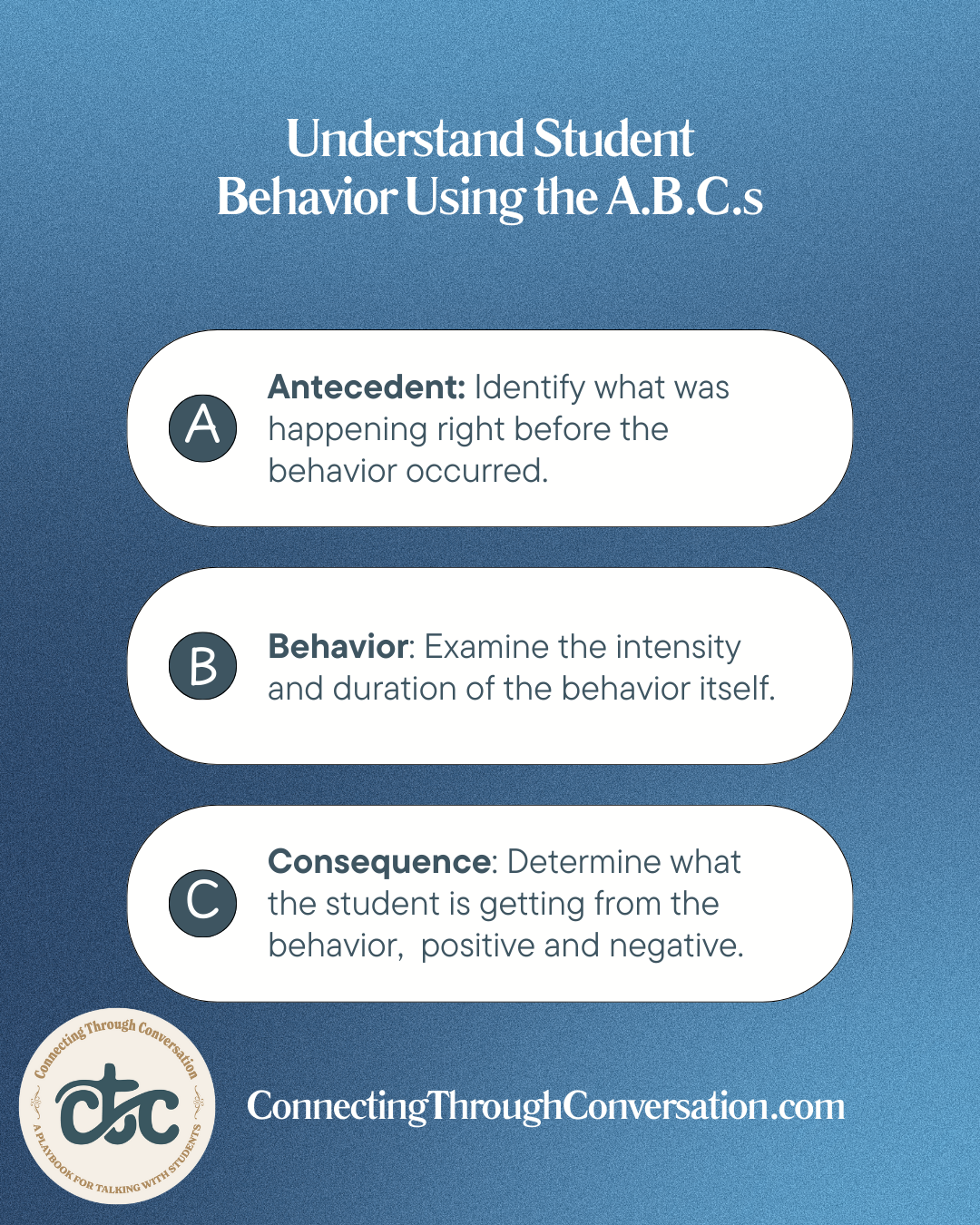
When this is the case, we advise that you focus on the A.B.C.s: Antecedent, Behavior, and Consequence. This approach was coined by the grandfather of behaviorism, B.F. Skinner. When we examine the behavior closely through this framework, it allows us to see the behavior clearly so we can focus on what will make the needed change. So, let’s take a look at each part.
Antecedent
The antecedent is what happened right before the behavior. This could be anything from what the student was asked to do, a change in environment, coming in from recess, getting ready to make a transition, etc. When thinking about the antecedent, we are looking for patterns.
Do we see a spike in behavior every time the student is asked to do a challenging task?
Does the student consistently struggle with transitions?
Maybe they are having difficulty moving from unstructured to structured tasks.
If we can identify the pattern, then we have a way to anticipate and plan for challenges.
Behavior
Examining the behavior can be helpful in ensuring that we are focusing on actual facts. Sometimes a behavior is so irritating we exaggerate it in our own mind. There are also times that we have seen a behavior so many times we fail to notice any changes over time. For these reasons, and others, it is important to pay attention to the intensity and duration of a behavior. In other words:
Consider the extent of the behavior and how long it lasts.
Then, when we start to implement a plan, we will know not to abandon it too soon if we can clearly see the duration or intensity is improving (even if it might not feel like it!).
Consequence
At CTC, when we are talking about consequences, we are talking about what the student is getting out of the behavior, not what disciplinary action they might receive. So, when a student tells an inappropriate joke at an inopportune time, a consequence might be that the other students laugh and they get some peer attention. It might also be that they get sent out of class and are able to avoid a task. Most likely, it is both!
When we dig into what the student is truly getting out of the behavior it can help us guide the adult move to ensure whatever consequence they get from us is not inadvertently reinforcing the behavior we don’t want to see!
It can also provide insights into how we can meet the need they are filling in ways that work better for school.
Understanding Leads to Plans that Actually Work
When we carefully examine the A.B.C.s of a student's behavior, it will lead to a deeper understanding of what is driving it in the first place. This is especially important when what is driving the student behavior is not clear to us. It also helps us drive out a lot of the noise around what is happening and allows us to really focus on the behavior so we can make a plan to eliminate it.
This is part of our Escape the Behavior Trap Blog Series.
We’re continuing to dig into why students get stuck in unhelpful behavior cycles - and what actually helps them break out of them. Stay tuned for more!
Want to go deeper?
We recently hosted our training Escape the Behavior Trap, where we break down why traditional responses don’t work - and what to do instead.