Escape the Behavior Trap: Part 2
4 Simple Replacement Behaviors That Make A Surprising Difference
What Students Need Instead

In Part 1, we explored the four hidden reasons behind student behavior (you can read Part 1 here).
Once we understand why a behavior is happening, the next step is identifying what the student can do instead - a behavior that meets the same need in a more productive way.
This is where replacement behaviors come in.
What Is a Replacement Behavior?
A replacement behavior is a more effective action that meets the same need as the original behavior.
Why Replacement Behaviors Matter
Students rely on challenging behaviors because, on some level, those behaviors work for them. A replacement behavior gives them another option that works better - for them and for the learning environment.
Replacement Behaviors That Actually Work
1. Escape
When a student feels overwhelmed, confused, embarrassed, or overloaded, they often try to get away - physically or by disengaging. Replacement behaviors give them a way to access support without leaving the task completely.
Examples:
Asking for clarification
“Can you show me another way?”
“I’m not sure how to start.”Requesting a short pause
A brief reset, step-out, or quiet moment before re-engaging.Choosing how or where to begin
Starting with a smaller portion of the task or moving to a spot with fewer distractions.Using a check-in to initiate
A quick check-in from an adult that helps the student enter the work instead of avoiding it.
2. Attain Connection
Connection-seeking behaviors are attempts to feel seen, reassured, or engaged. Replacement behaviors give students predictable ways to get connection without interrupting or derailing learning.
Examples:
Using a nonverbal signal for attention
A hand signal, card, or designated spot that communicates “I need you.”Requesting a check-in
- “Can we talk after this?”
- “Can you check in with me when you’re free?”Relationship routines
Brief routines for greeting or sharing that reduce the need to seek connection mid-task.Peer-engagement strategies
Ways to join a group, ask for help, or enter a conversation respectfully.
3. Tangible Gain
When students want something - time, materials, a device, a role, or access to a preferred activity - the replacement behavior needs to help them communicate that want in a productive way.
Examples:
Negotiating or asking for options
“Can I finish this at the break?”
“Can I choose between these two?”Using a First/Then plan
A clear path that feels fair and predictable.Requesting access respectfully
“Can I use that when you’re done?”
“Can I have a turn next?”Working toward structured choice or privileges
A transparent way to earn access instead of pushing limits to get it.
4. Sensory Needs
When behavior is driven by sensory needs - seeking more input, avoiding overwhelming input, or feeling grounded in their body - replacement behaviors give students safe and appropriate ways to regulate.
Examples:
Using sensory tools appropriately
Fidgets, gum, textured items, doodling.Taking a movement or grounding break
A quick walk, stretch, or breathing reset.Choosing a different workspace or seating option
Standing desk, floor seating, leaning against a wall, or a quieter corner.Naming sensory overload early
“It’s too loud.”
“The lights are too bright.”
“I need a quieter spot.”
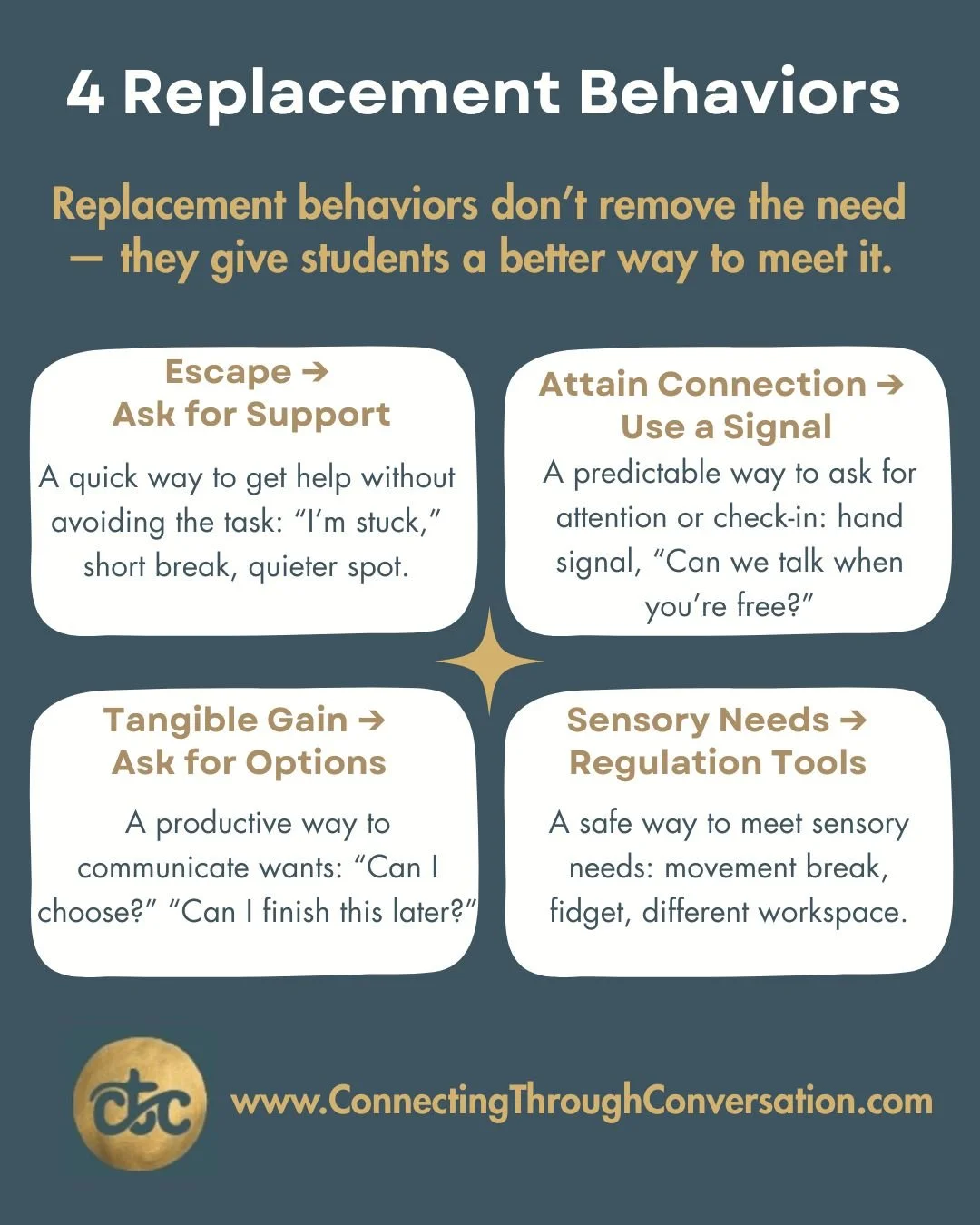
The Shift
Replacement behaviors don’t stop the need or feeling. They give students a better option to meet that need in a more productive way.
When the new behavior works, students begin to use it.
This is part of our Escape the Behavior Trap Blog Series.
We’re continuing to dig into why students get stuck in unhelpful behavior cycles - and what actually helps them break out of them. Stay tuned for more!