

4 Powerful Hidden Reasons Behind Student Behavior
Understanding the Why Behind Behavior

A student’s behavior is what they did, not who they are.
This is a core belief of ours here at CTC. As educators, we’re usually pretty comfortable having a growth mindset around academics. We expect students to make mistakes. We even encourage them, celebrate them, and use those mistakes to help students learn and grow. We work hard to create classrooms where students feel safe getting things wrong so they can improve.
But we don’t always treat behavioral mistakes in the same way.
This is often where we unintentionally slip into what we call the Behavior Trap - reacting to the surface behavior instead of the need underneath it.
When a student’s behavior affects safety, disrupts the class, or causes harm, it’s easy to move straight into “problem-solving mode.” And we get it.
Challenging behaviors are so hard - on all of us. When it happens, we’re trying to teach, monitor, support, and keep everyone safe all at the same time.
But just like we examine why a student made an academic mistake, we can examine why the behavioral mistake happened. When we pause long enough to look for the reason behind the behavior, we set ourselves up to respond more effectively.
All behavior communicates a need or a feeling.
When we miss the need, we get stuck in the Behavior Trap: the student repeats the behavior, we repeat the response, and nothing actually changes.
If we start seeing behavior as information - and pay attention to what that information is telling us - we can identify the underlying need the student may not even know how to name yet.
When we identify the need underneath the behavior, something important shifts:
Students separate the action from their identity so they can see their behavior as changeable.
We understand what’s driving the behavior, which gives us a clear path to support real change.
One of the most effective ways to begin escaping the Behavior Trap is to understand the purpose behind the behavior. A helpful frame from Learning for Justice is to examine EATS.
The 4 Hidden Reasons Behind Behavior
1. Escape
The student is trying to get away from something that feels overwhelming, confusing, embarrassing, or unsafe. This might look like avoiding work, leaving the room, shutting down, or acting out to create distance.
Example: A student who suddenly cracks jokes, argues, or “needs to go to the bathroom” right when a challenging task is assigned may be trying to escape the feeling of not understanding the work.
2. Attain Connection
Many people refer to this as “attention-seeking,” but we frame it as connection-seeking because what students truly want is engagement, reassurance, or relationship. The behavior may be an attempt to get someone (adults or peers) to notice them, interact with them, or help them feel seen and valued.
Example: A student who repeatedly calls out, interrupts, or hovers near the educator may be trying to draw the adult into interaction or connection, even if the only connection available in that moment is negative.
3. Tangible Gain
The student is trying to get something concrete. This could be an item, a preferred activity, more time, a specific seat, or anything they see as a reward or benefit.
Example: A student who refuses to transition, negotiates, or argues may be trying to gain extra time with a preferred activity or avoid losing access to something they want.
4. Sensory Needs
The student is reacting to sensory input or trying to meet a sensory need. This includes noise, light, touch, movement, or internal regulation needs like calming their body or staying alert.
Example: A student who covers their ears or hides under a desk during loud activities is trying to block sensory overload, while a student who taps, fidgets, moves constantly, or seeks pressure may be trying to get more sensory input to regulate their body.
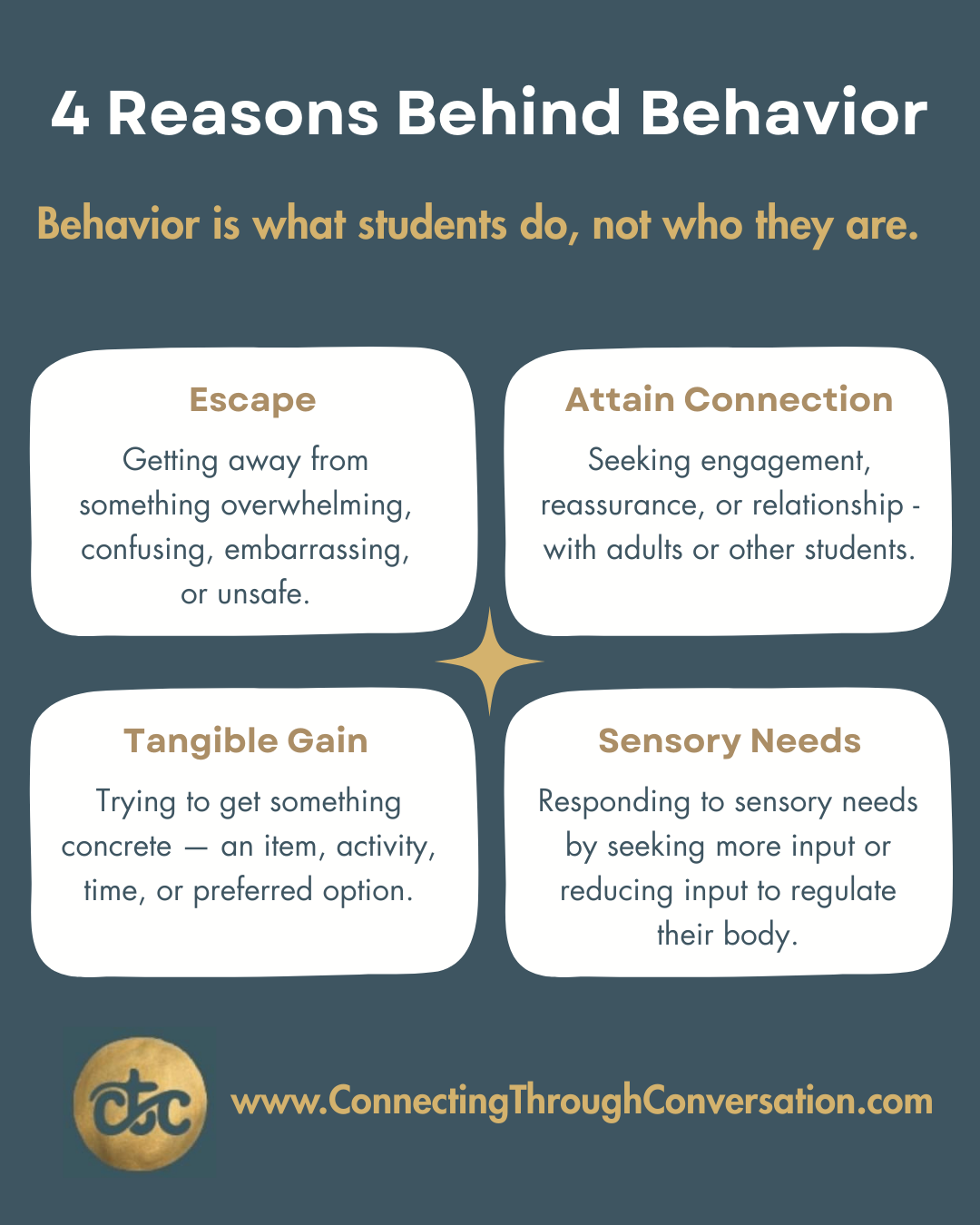
Understanding which of these needs is driving the behavior helps us respond with far more accuracy. When we know the why, we can support students in meeting the underlying need and learning new behavioral skills instead of reacting only to the surface behavior.
This is part of our Escape the Behavior Trap Blog Series, where we dig deeper into why students get stuck in unhelpful behavior cycles - and what actually helps them break out of them. Stay tuned for the next installment.
Want to go deeper?
We just hosted our webinar Escape the Behavior Trap, where we break down why traditional responses don’t work - and what to do instead.
The full replay is now available on our website for $14.99.
You’ll get:
The full training recording
Downloadable slides
Practical tools you can use immediately