Escape the Behavior Trap Blog Series: Part 4
Make a plan that really works!

In the first 3 installments of this series, we explored the often hidden reasons behind student behavior and what the student can do instead. We also dug into examining a student’s behavior using the A.B.C.s (Antecedent, Behavior, and Consequence). Now, we are going to pull it all together to make a plan that will create lasting change in the student’s behavior.
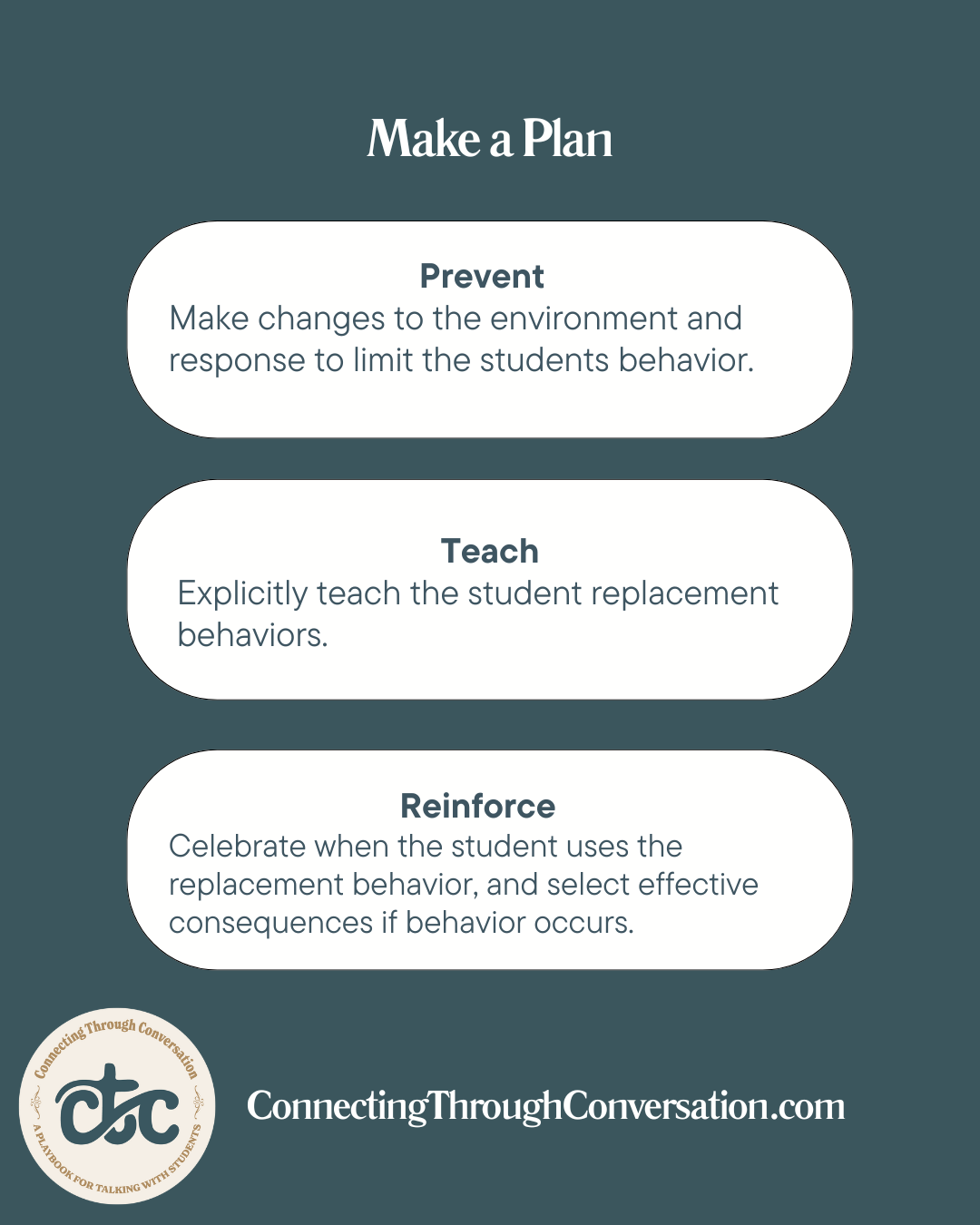
Prevent
After examining the antecedents of the behavior using the A.B.C.s, we have an idea of what is happening to trigger the behavior. We now use this to examine our environment, our response, and the student’s schedule to see if anything should be adjusted to prevent or limit the likelihood of the behavior repeating.
Next, we are going to consider the consequences the student experiences when they engage in the problematic behavior.
Did they get students to laugh?
Did they get out of an assignment?
Did they get to spend time with a preferred adult?
We use this information to determine what function the behavior was serving for them and find ways we can meet this need in more productive ways.
Teach
Now we get to the best part! We get to teach them. We know that students are most often doing the best they can with the skills they have. It is our job to teach them how to communicate their needs in a way that will work for both them and us. So, we explicitly teach the student replacement strategies to meet their needs.
If they are looking to escape, we work together on productive ways to take a break so they can reengage.
If they are connection seeking with their peers, we provide social tools for them to do this in a productive way or a structured time in their day to meet this need.
The key here is to identify the skill that the student needs to develop and then teach it to them. Like any new skill, it will take practice and repetition for the student to internalize it.
Reinforce
Once they have learned the new skill and are using replacement behaviors, even if only occasionally, we reinforce the heck out of it every time they use it.
By reinforcing what we want to see more of, we will get more of it.
We also want to carefully consider the consequences the student receives, both positive and negative, when they engage in the problematic behavior.
Match your response to this behavior to avoid doing anything that may inadvertently reinforce the behavior. By removing any reinforcement for the challenging behaviors, we will begin to see it less often.
Tying it all Together
By striving to understand what is driving a student’s behavior and examining the behavior closely you can make a plan that will truly help both the student and you! When you are really struggling with supporting a student, we strongly encourage you to bring it to some of your colleagues.
Ask another educator what they see as the function of the behavior.
What consequences do they see as reinforcing the behavior?
What skills need to be taught?
They may see something you missed.
We have provided a free resource found here to guide you through the process of escaping the behavior trap. Let us know how it is going, and please reach out if you need a thought partner. Addressing a student’s challenging behavior is not easy, but when we take the time to understand it and develop a plan we will make a real difference.
This is part of our Escape the Behavior Trap Blog Series.
We’re continuing to dig into why students get stuck in unhelpful behavior cycles - and what actually helps them break out of them. Stay tuned for more!
Want to go deeper?
We recently hosted our training Escape the Behavior Trap, where we break down why traditional responses don’t work - and what to do instead.